"Source Material Knowledge" in Recycled Aggregate Documentation – Why Does It Matter?
What is "source material knowledge" in the context of recycled aggregates and why is it crucial for the quality, consistency, and approval of these materials for construction applications?
What Is "Source Material Knowledge"?
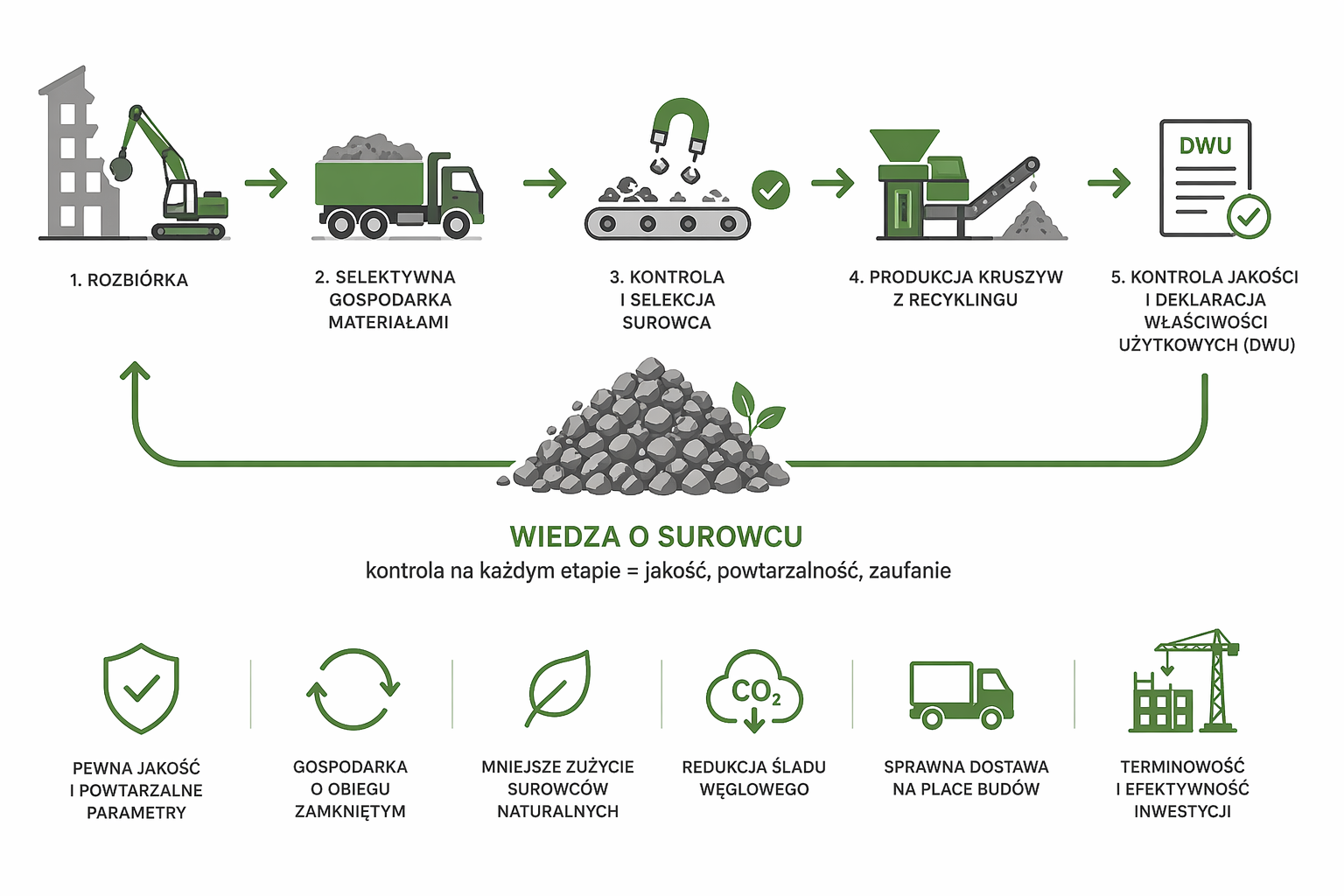
In the case of recycled aggregates, one of the key factors determining their quality, consistency, and eligibility for construction applications is "source material knowledge" – understood as a documented and controlled body of information about the input material, encompassing its origin, composition, and the influence of these characteristics on the product's performance properties. It allows recycled aggregate to be treated as a consciously manufactured construction product compliant with normative requirements, rather than as an uncontrolled waste material.
TREE Group's Approach
At TREE Group, we implement this approach through a coherent and controlled process covering all stages – from demolition works, through selective material management, to the production of recycled aggregates at our own processing facilities. "Source material knowledge", referenced in our Declarations of Performance (DoP), relates to the type and origin of the raw material used in the production process and forms the basis for effective quality control of the final product.
What Does "Source Material Knowledge" Mean in Practice?
For TREE Group, "source material knowledge" means in particular that:
- we know the origin of materials generated through demolition and construction works,
- we eliminate foreign contaminants and unwanted materials already at the initial sorting stage,
- we carry out selective collection and control of raw material prior to processing,
- we manage raw material variability within the Factory Production Control system,
- we confirm the performance properties of aggregates through tests carried out in accordance with applicable standards.
Significance for the Construction Market
"Source material knowledge" understood in this way constitutes a crucial basis for classifying recycled aggregates as fully-fledged construction products meeting specific technical and normative requirements. This enables a shift away from perceiving these materials solely as waste and allows them to be used as products with known, predictable performance properties approved for specific engineering applications.
From the perspective of designers, investors, and construction supervision authorities, this is one of the key elements in assessing material quality and the credibility of the manufacturer.
Availability and Logistics
Thanks to its own recycling facilities, TREE Group ensures the constant availability of recycled aggregates with controlled and repeatable parameters, constituting a real alternative to natural aggregates. Appropriate organisation of processing and logistics enables efficient delivery of materials to construction sites, directly contributing to the timeliness and effectiveness of investment projects.
Sustainable Development and the Circular Economy
TREE Group's activities are aligned with the principles of sustainable development and the circular economy through:
- local management of demolition materials,
- reduction of primary raw material consumption,
- minimisation of waste,
- reduction of the carbon footprint of construction investments.
The reuse of mineral materials, while maintaining required quality and technical parameters, allows for minimising the negative environmental impact of construction processes.
Tags
Share this analysis
About the author
Iwona Wagner
Expert in Research and Development of Recycled Material Technologies
Category
Innowacje w recyklingu
Reading time
5 minutes
Publication date
April 24, 2026
Available in other languages
🇵🇱 Polish versionSimilar analyses
Modern Demolition Technologies: Comparative Analysis and Development Trends
Comprehensive analysis of contemporary demolition technologies, their efficiency, environmental impact, and economic via...

Efficiency Analysis of Liebherr Machines in High-Rise Building Demolition Processes
Comprehensive efficiency analysis of Liebherr demolition excavators in high-rise building demolition projects. The study...